
In Defense of Raw Milk
A Philosophical Defense
Raw milk is unpasteurized milk. Pasteurization is a process of heating the milk to high temperatures to kill harmful bacteria and pathogens. Raw milk, in my home state of Indiana, is illegal to sell to humans. The stated reason for this is sound. Milk “intended for pasteurization” and sourced from Concentrated Animal Feeding Operations (CAFOs) is, in fact, unsafe to consume raw. I detailed the unsanitary conditions of these operations in my last essay on How America Broke Food. Let me clarify at the outset: this is not what I aim to defend.
I aim to defend the type of raw milk intended for direct human consumption from small American farms that take great care of their cows. We currently purchase this type of raw milk from a local farm and we must do it under the guise of buying “pet milk” because it is illegal to sale raw milk of any kind in my home state.
I also don’t intend to put raw milk on some kind of food pedestal, to argue it is a magic elixer that will heal all of your ailments. This kind of silver bullet thinking frustrates me, especially in the realm of nutrition. Nutrition is complex. People are different. Many different diets and foods can work.
I make the case for raw milk for two reasons. First, it is a delicious, nutritious food that is currently illegal. Second, because I believe it to be a symbol for raw living foods in general - foods that contain the nutrition and probiotics our modern bodies crave so much. If you are vegan, you can swap raw milk out for raw sauerkraut, although you’d have to imagine unpasteurized sauerkraut was illegal, which at least in my state, it is not. Lastly, while on the topic of fermentation (which we will get into in part 2), raw kefir and raw yogurt are even more beneficial than raw milk, being fermented raw milk products.
Philosophy Precedes Empiricism
I decided to break this essay into two parts. Part 1 will be more philosophical. Part 2 will be more of your standard evidence-based defense of raw milk.
Our culture underrates philosophical understanding and overrates empirical understanding. This betrays how our minds actually work. I’ll be the first to admit, I am pro raw milk, first and foremost on philosophical grounds. Like it or not, that is the lens with which I interpret the empirical data. C.S. Lewis puts it well at the very beginning of his book, Miracles:
“What we learn from experience depends on the kind of philosophy we bring o experience. It is therefore useless to appeal to experience before we have settled, as well as we can, the philosophical question.”
This applies even to experimental science and especially to the interpretation of data. Otherwise, what would be the need for double-blind studies?
This is not to completely discount the empirical. The empirical gives the philosophical skin in the game. If the empirical contradicts the philosophical, the latter must change. It’s about order of operations and philosophical is the source. It even determines what kind of empirical questions we ask and which ones we ignore.
Therefore, this first part will attempt to establish why this is an important question to analyze empirically in the first place: Why does raw milk matter?
Medicine 3.0
Medicine 3.0 is a concept popularized by Dr. Peter Attia in his book Outlive: The Science and Art of Longevity. It's his vision for a more proactive, personalized, and prevention-focused approach to health and longevity. A new era for medicine that builds further upon the incredible breakthroughs of Medicine 2.0, which itself marked a major leap from Medicine 1.0—a time when treatments were based largely on tradition, superstition, and limited scientific understanding. Medicine 2.0 introduced evidence-based practices, modern diagnostics, and pharmaceuticals, making it highly effective at treating acute conditions. However, it remains largely reactive, addressing disease only after it appears. Medicine 3.0 aims to go further by focusing on early detection and lifestyle interventions to prevent disease and extend both lifespan and healthspan.
I believe Medicine 2.0’s reactive bias is downstream from a more pervasive bias: Medicine 2.0 succeeds primarily in killing the bad rather than fostering the good.
This is further upstream than even medicine. I believe this to be a widespread cultural bias. I’ve seen the same biases in farming. Industrial agriculture is far more concerned with creating more innovative and intense ways to kill pests and disease than fostering healthier plants and ecosystems that can more innately defend themselves against weed and disease pressure.
In his book, A Bold Return to Giving a Damn, regenerative farmer Will Harris recounts his transition from conventional cattle production to a regenerative approach. Will stated his job used to be waking up and figuring out what he needed to kill that day. Weeds growing along the fence line? Break out the herbicide. Pest issue? There’s a pesticide for that. Fungal issue? Fungicide should do the trick. The latin root, “cide” means “killing” or “killer of”. Will was an expert killer of things with his arsenal of “cides”. As a regenerative farmer, Will’s frame has shifted to figuring out what kind of life he can add to his system to alleviate issues. Adding chickens to his cattle operation eliminated the need for certain pesticides because the chickens ate the fly larva before they could hatch and affect the cows.
To find this same “cide” bias in medicine, we need to look no further than the pride of Medicine 2.0 itself, the antibiotic. The latin roots of antibiotic literally mean against life.
Now, I like antibiotics just as much as I like Medicine 2.0. I’m supremely grateful to not live in the middle ages. But name betrays the bias of the entire philosophical framework of medicine, and much of our culture in general.
For the philosophy nerds, its amazing how well this Medicine 3.0 narrative fits within Hegel’s historical dialectic. In this framework, the famous philosopher G.W.F. Hegel, argues history unfolds as a dialectic - a kind of conversation.
In step 1, you have a thesis: some kind of pre-existent status quo.
What follows is a cultural antithesis: an opposing idea or force challenges the thesis, highlighting its limitations or contradictions.
Finally, a synthesis: the antithesis goes to far in its rejection of the thesis, but eventually unity is reached by reintegrating the valid aspects of the original thesis into its antithesis.
Medicine 1.0 is the thesis. Medicine 2.0 is the antithesis. Medicine 3.0 is the synthesis.
I believe antibiotics (and pesticides) are worthy symbols of this cultural antithesis.
History may have unfolded in this direction simply because its easier to destroy something than it is to create something. As we have developed more autonomy over the natural world, it was inevitable that we would learn to leverage nature’s power to destroy before learning to leverage nature’s power to create. At least that’s the most optimistic rationalization I have for this bias. Nonetheless, we must move past it for the sake our survival and health.
If antibiotics are a symbol of the antithesis, then our culture’s growing respect for probiotics must be an harbinger of its synthesis. The below google search trend chart shows the steady growing interest in probiotics over the last two decades.
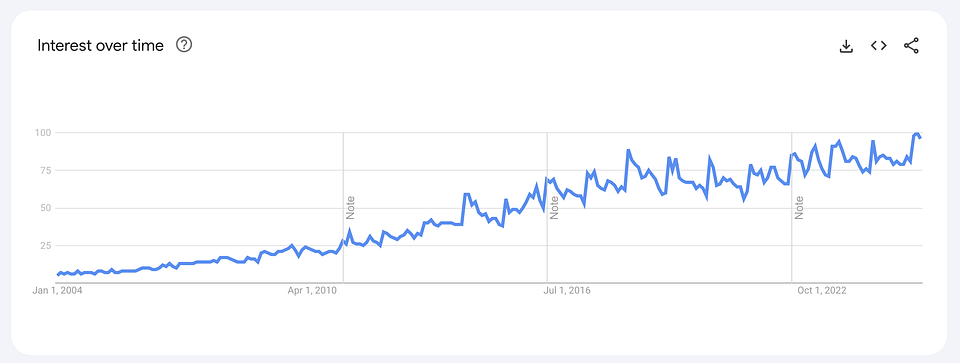
This shift is cultural consciousness is happening at a necessary time. There is a serious problem at the root of a cultural philosophy at war with life: life finds a way. For a culture that nearly worships evolution its a bit ironic that we’ve set our camp up on the opposite side.
Consider pesticides: The problem with pesticides is that, in a population of pests, the odds that some of them will be naturally immune to the pesticide is guaranteed given a large enough population, and the population of pests is quite large! Therefore, in the long run, all you are doing is applying the evolutionary pressure to create stronger pests. You might win some battles, but you are waging a war that you are guaranteed to lose.
Unfortunately the same exact logic is at play right now with antibiotics. We are applying intense evolutionary pressure on pathogenic bacteria. In the process, creating antibiotic resistant super bugs. This is quickly becoming a very serious reality. The CDC’s Antibiotic Resistance Threats Report for 2019 concluded the following stats:
“CDC's 2019 AR Threats Report includes national death and infection estimates that underscore the continued threat of AR in the United States. More than 2.8 million antimicrobial-resistant infections occur in the U.S. each year, and more than 35,000 people die as a result. When C. diff is added to these, the U.S. toll of all the threats in the report exceeds 3 million infections and 48,000 deaths.”
For comparison, the FDA estimates per year, “9 million people get sick, 56,000 are hospitalized and 1,300 die of food borne disease caused by known pathogens.”
37x more people die from antibiotic resistant infections in the US than food borne illness. Of course, the food borne illness number is low because of the tremendous success of Medicine 2.0. However, the number antibiotic resistant deaths is consistently growing every single year and in a sense, it is caused by Medicine 2.0. We need a Medicine 3.0.
On Scale
Maybe your thinking, I thought this was an essay about raw milk? The point I am trying to make is that I believe this to be the same fundamental battle being waged at different scales. It is in this sense I use raw milk as a symbol of something bigger.
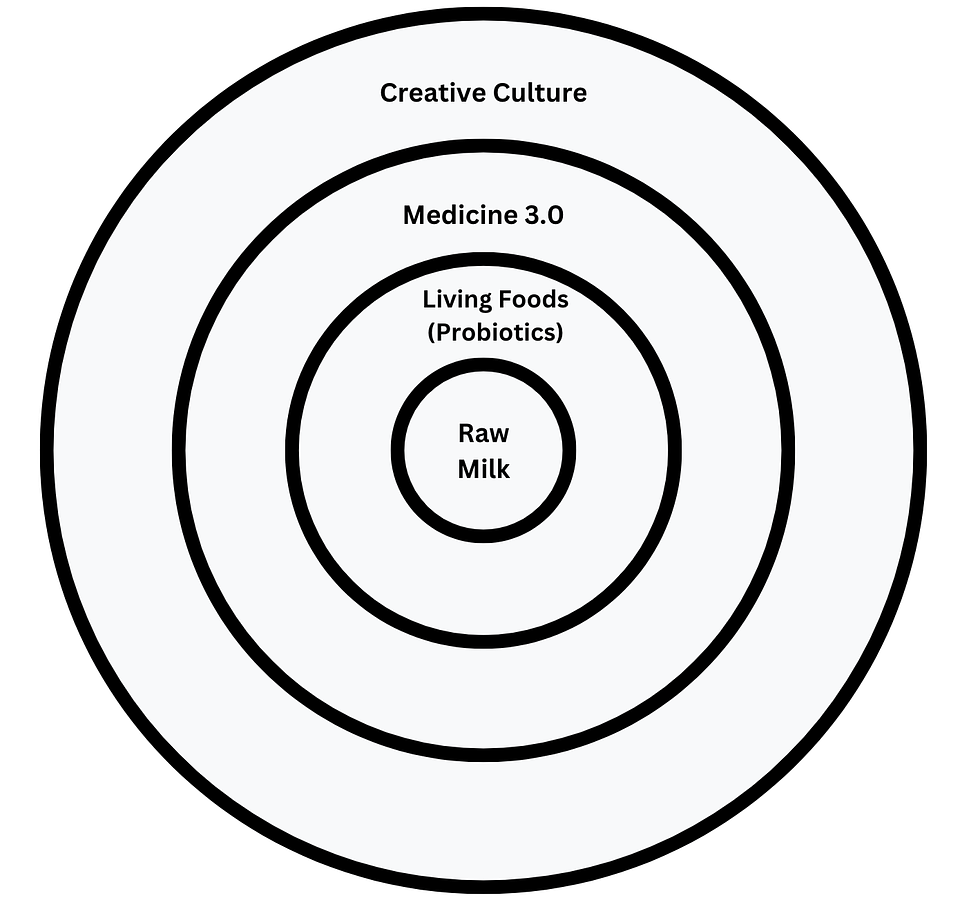
We can and should begin to solve more of our personal and social problems by fostering the good instead of merely killing the bad. Why not start with our gut health? More on that in Part 2 of In Defense of Raw Milk.